
––––––––––––––––
02 — RESEARCH
–––––––––––
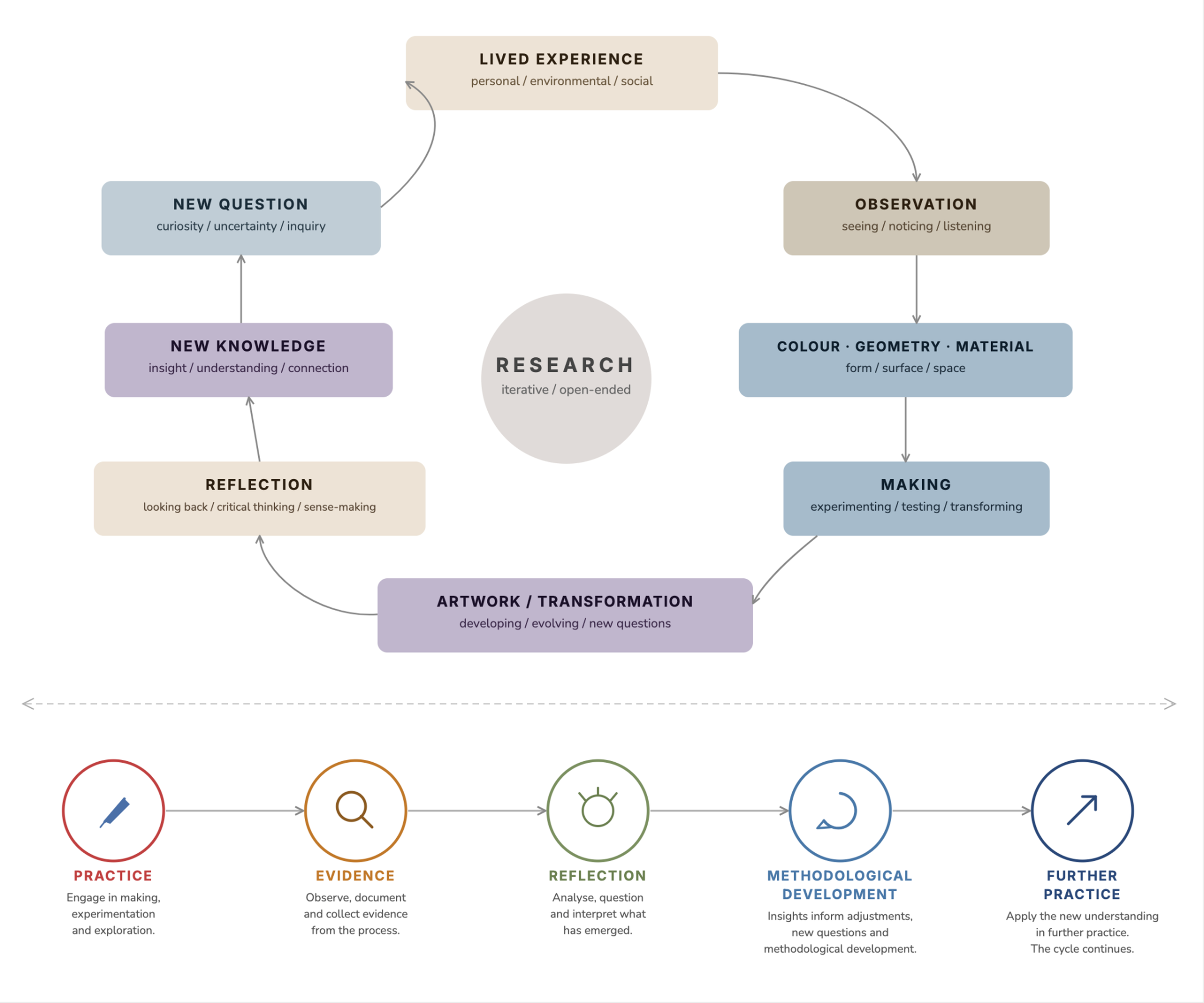
DIAGRAM 1
PROPOSED DOCTORAL RESEARCH
My artistic practice has developed across communication design, artistic production, education, and cross-cultural encounters, shaping a sustained interest in colour, geometry, form, material, and space, and in the relationship between lived experience and visual expression.
The proposed doctoral research brings these strands of practice together to investigate how lived experience can be transformed through artistic making into new forms of visual, spatial, and material knowledge.
The research explores how making can move beyond representation, becoming a process through which experience can be explored, questioned, and understood differently.
––––––––––––––––—–––
RESEARCH QUESTION
How can lived experience become new knowledge through colour, form, and making?
This question frames an investigation into what can emerge through observation, experimentation, reflection, and artistic making, and how these processes can contribute to new ways of perceiving and understanding lived experience.
–––––––––––––––
RESEARCH AIM
The research investigates how lived experience can be transformed through artistic practice into new forms of visual, spatial, and material knowledge.
The investigation develops through sustained experimentation with:
colour · geometry · material · form · space
Artistic practice is used not simply to produce artworks, but as a means of investigating what can be discovered, understood, and generated through the process of making itself.
–––––––––––
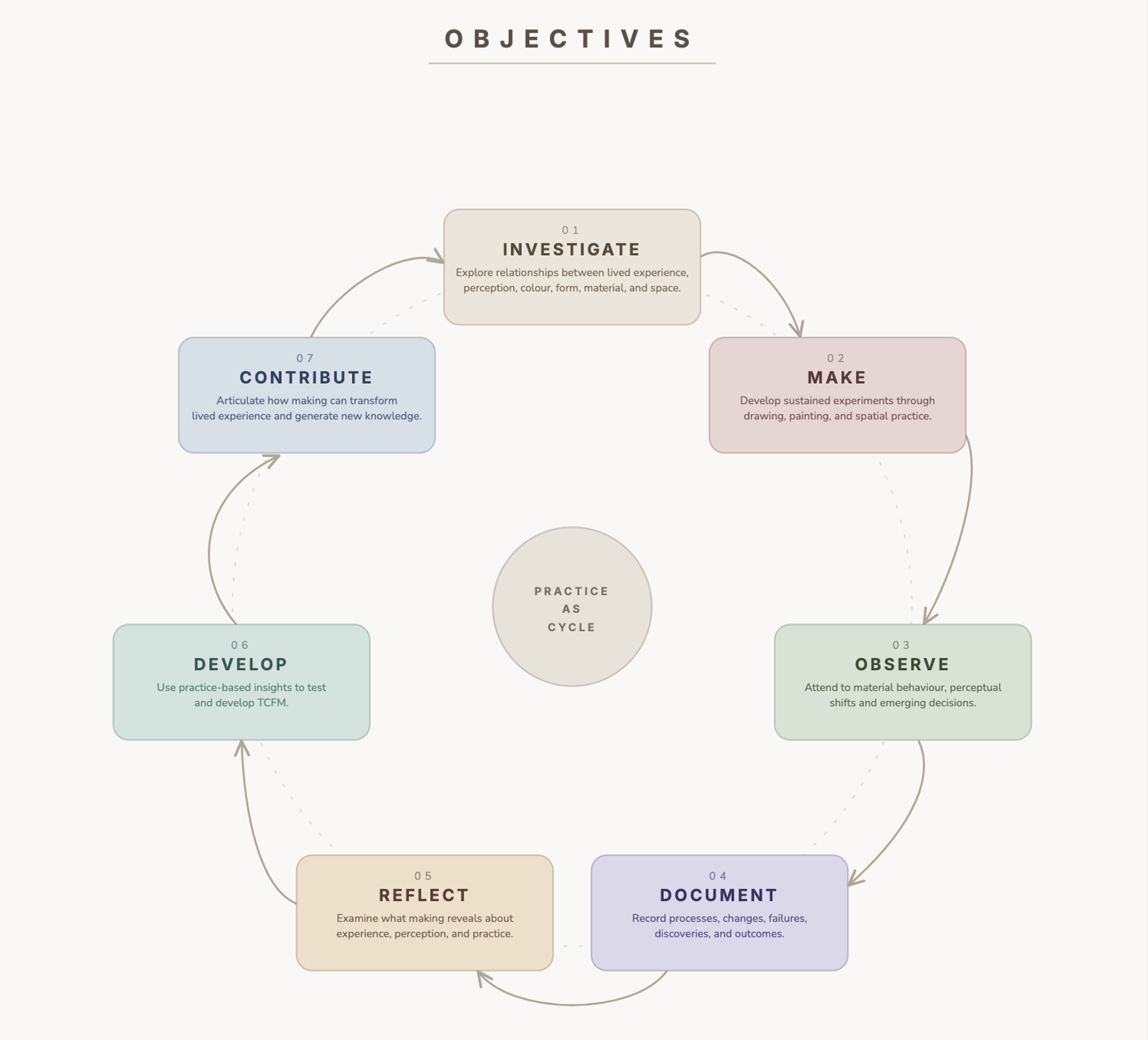
DIAGRAM 2
–––––––––––
DIAGRAM 4
THREE-YEAR RESEARCH DEVELOPMENT
The research will develop iteratively across three years, with each stage informed by artistic practice, critical reflection, and questions emerging through the work.
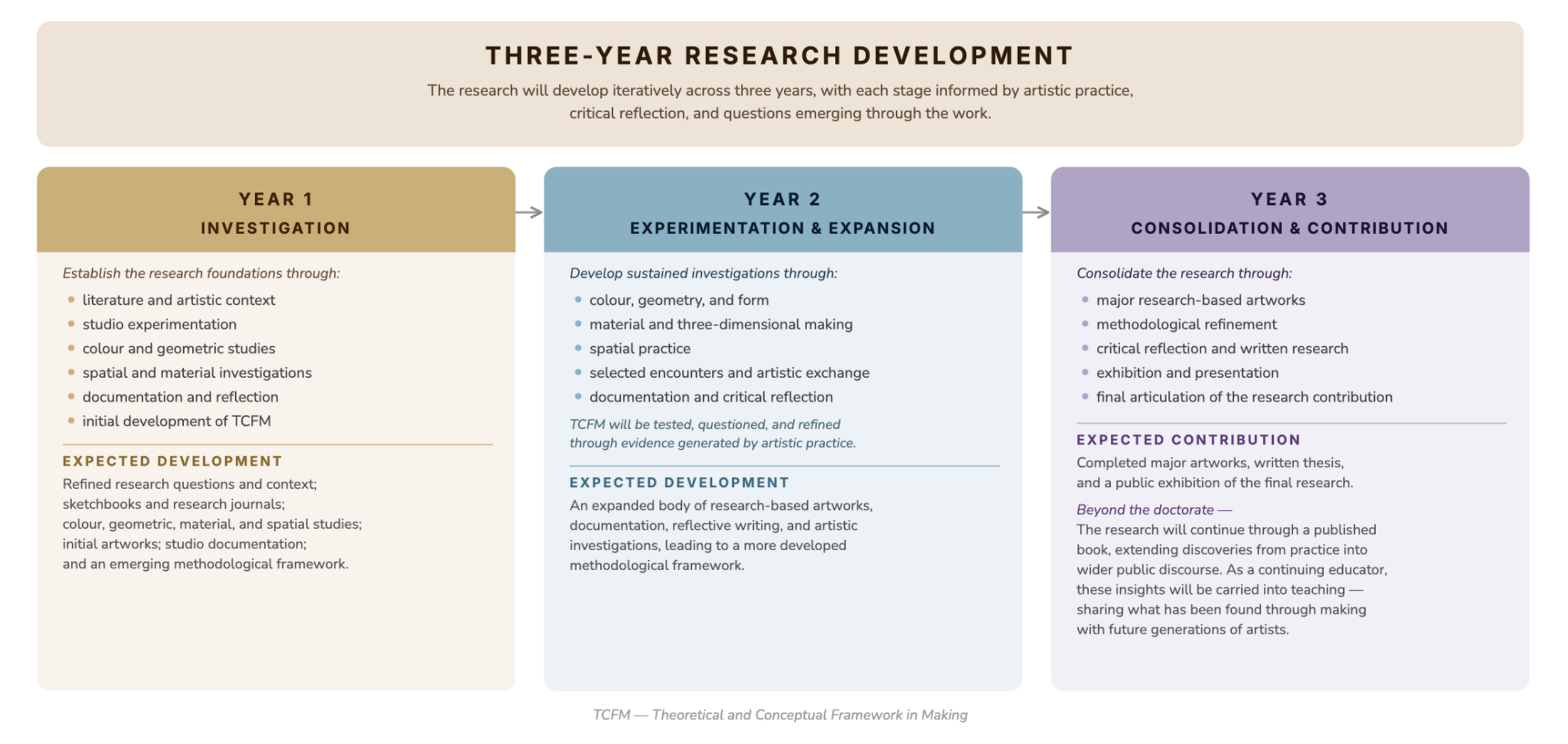
THREE-YEAR RESEARCH DEVELOPMENT
The research will develop iteratively across three years, with each stage informed by artistic practice, critical reflection, and questions emerging through the work.
YEAR 1 — INVESTIGATION
Establish the research foundations through:
● literature and artistic context
● studio experimentation
● colour and geometric studies
● spatial and material investigations
● documentation and reflection
● initial development of TCFM
EXPECTED DEVELOPMENT
Refined research questions and context; sketchbooks and research journals; colour, geometric, material, and spatial studies; initial artworks; studio documentation; and an emerging methodological framework.
YEAR 2 — EXPERIMENTATION & EXPANSION
Develop sustained investigations through:
● colour, geometry, and form
● material and three-dimensional making
● spatial practice
● selected encounters and artistic exchange
● documentation and critical reflection
TCFM will be tested, questioned, and refined through evidence generated by artistic practice.
EXPECTED DEVELOPMENT
An expanded body of research-based artworks, documentation, reflective writing, and artistic investigations, leading to a more developed methodological framework.
YEAR 3 — CONSOLIDATION & CONTRIBUTION
Consolidate the research through:
● major research-based artworks
● methodological refinement
● critical reflection and written research
● exhibition and presentation
● final articulation of the research contribution
–––––––––––
DIAGRAM 3
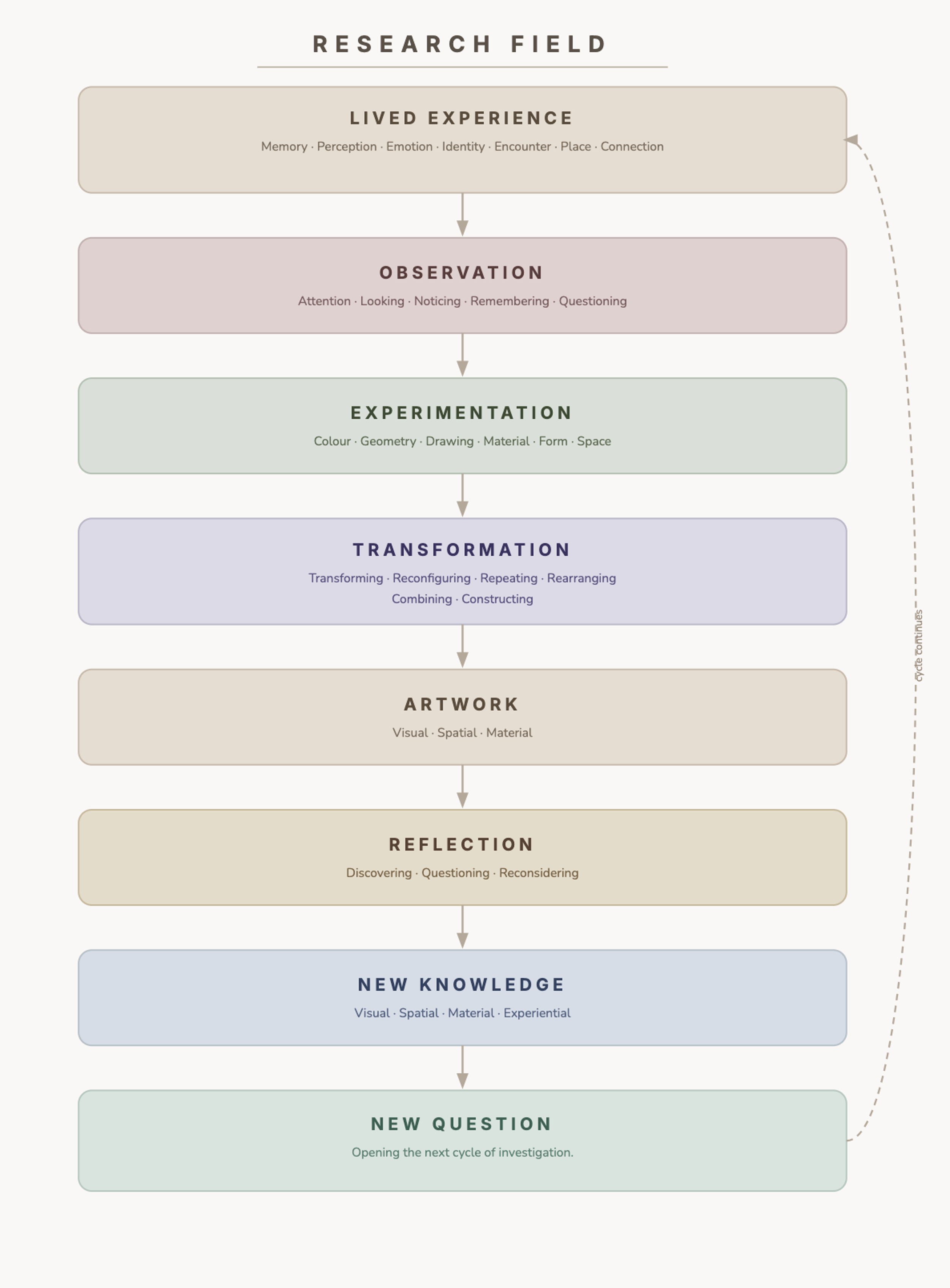
RESEARCH FIELD
LIVED EXPERIENCE
Memory · Perception · Emotion · Identity · Encounter · Place · Connection
↓
OBSERVATION
Attention · Looking · Noticing · Remembering · Questioning
↓
EXPERIMENTATION
Colour · Geometry · Drawing · Material · Form · Space
↓
TRANSFORMATION
Transforming · Reconfiguring · Repeating · Rearranging · Combining · Constructing
↓
ARTWORK
Visual · Spatial · Material
↓
REFLECTION
Discovering · Questioning · Reconsidering
↓
NEW KNOWLEDGE
Visual · Spatial · Material · Experiential
↓
NEW QUESTION
Opening the next cycle of investigation.
––––––––––––––––––––––––––
INTENDED CONTRIBUTION
A substantial body of research-based artistic work and a critically developed Transformative Colour–Form Methodology (TCFM) demonstrating how artistic practice can transform lived experience into new forms of visual, spatial, and material knowledge.
EXPECTED CONTRIBUTION
ARTISTIC CONTRIBUTION
A substantial body of artistic work investigating relationships between lived experience, colour, geometry, material, form, and space.
METHODOLOGICAL CONTRIBUTION
The development and critical examination of Transformative Colour–Form Methodology (TCFM) through artistic practice.
KNOWLEDGE CONTRIBUTION
New understanding of how lived experience can be transformed through artistic making into visual, spatial, and material knowledge.
PRACTICE-BASED CONTRIBUTION
A documented relationship between making, observation, transformation, reflection, and emerging knowledge, demonstrating artistic practice as a mode of enquiry.